Free AI Visibility Score — See how AI finds and cites your website
Answer Engine Optimisation (AEO) in 2026: What the Data Actually Shows

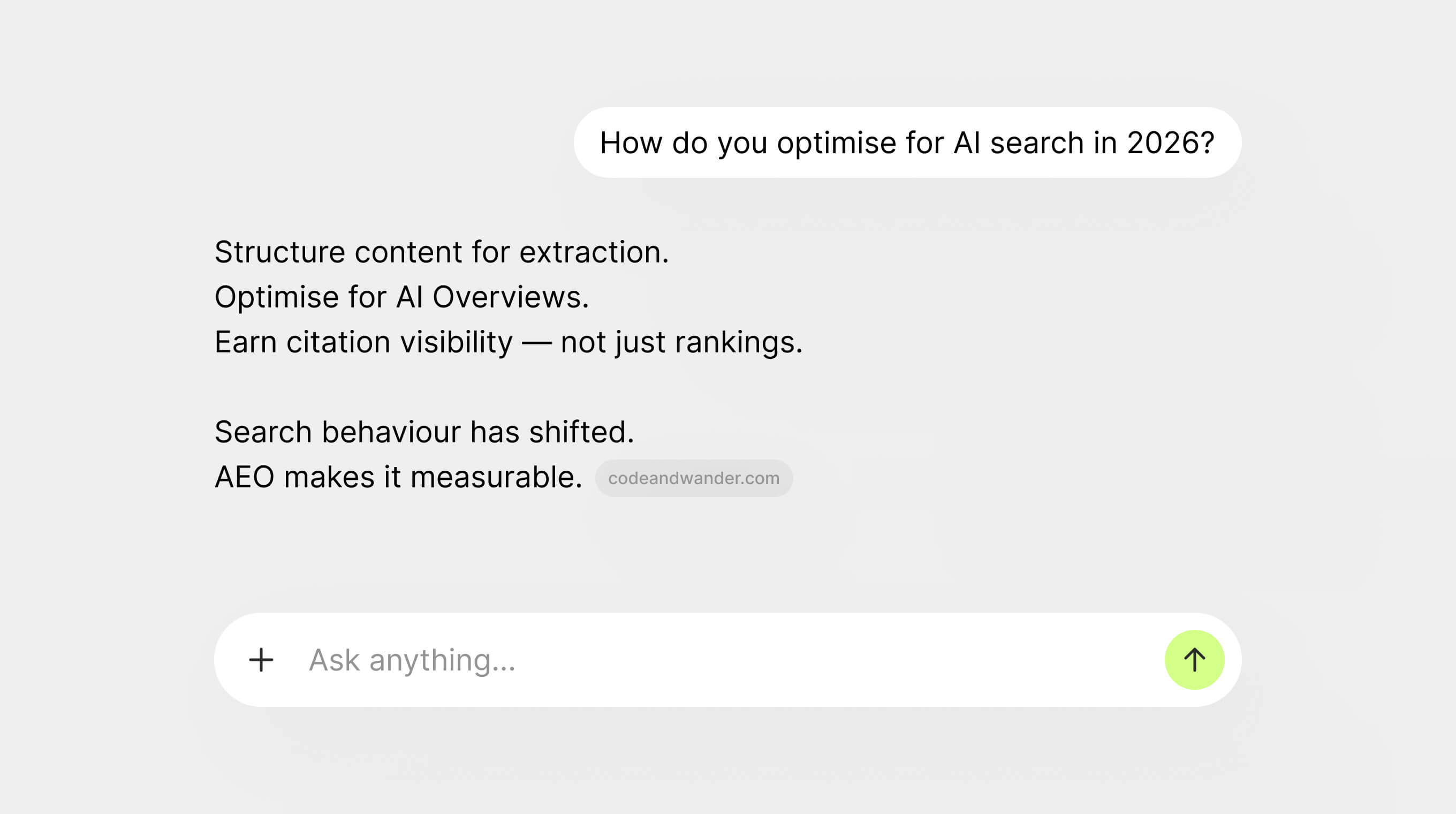
Over the past 18 months, the mechanics of discovery have changed. AI Overviews and generative interfaces are now embedded directly into results pages, altering how information is surfaced and consumed. Independent research and large-scale commercial datasets show sustained zero-click behaviour, measurable click-through rate compression, and increasing volatility in result composition. This article examines the evidence behind Answer Engine Optimisation (AEO) and what it means for long-term visibility and performance.
Search behaviour has shifted in measurable ways over the past 18 months. The emergence of AI Overviews and generative search interfaces has coincided with:
- Sustained zero-click search dominance
- Reduced click-through rates when AI summaries appear
- Increased regulatory scrutiny of AI content synthesis
This article examines independent research and large-scale commercial datasets to assess the current state of Answer Engine Optimisation (AEO) and its implications for SEO.
What Is Answer Engine Optimisation (AEO)?
Answer Engine Optimisation (AEO) refers to structuring and engineering content so it can be selected, cited, or synthesised by AI-powered search systems such as Google AI Overviews.
Traditional SEO focuses on ranking in organic results and earning clicks.
AEO focuses on visibility within AI-generated answers.
In practice, AEO addresses:
- AI Overviews
- Zero-click search environments
- Generative search systems
- AI citation visibility
- Entity recognition within large language models
It extends SEO rather than replacing it. For organisations formalising this shift, we outline our broader approach to search and AI visibility within our SEO, AEO & performance strategy services.
Zero-Click Search: The Pre-AI Baseline
Zero-click search behaviour predates generative AI.
SparkToro’s analysis of Semrush Datos clickstream data found:
- 58.5% of US Google searches ended without a click
- 59.7% of EU Google searches ended without a click
These figures were recorded before widespread AI Overview deployment.
This establishes a baseline: most searches already did not result in a visit to a publisher site.
AI features operate within this existing behavioural pattern. The difference is scale and surface area.
AI Overviews and Click-Through Rate (CTR) Impact
Independent behavioural research from Pew Research Center (March 2025) found:
- AI summaries appeared in 18% of sampled searches
- When an AI summary appeared, users clicked a traditional search result in 8% of visits
- When no AI summary appeared, click-through rate was 15%
This represents a substantial reduction in click propensity when generative answers are present.
Large-scale SEO platform datasets throughout 2025 reported similar patterns:
- Organic CTR compression on AI Overview-triggering queries
- Reduced performance for position-one listings when AI summaries appeared
While methodologies differ, the directional finding is consistent: AI-generated answers correlate with lower organic click-through rates.
For teams evaluating performance impact, this shifts the conversation from “ranking position” to broader AI search visibility and citation presence.
AI Overview Prevalence in 2025
Semrush tracking across millions of keywords reported:
- ~6.5% of tracked queries showed AI Overviews in January 2025
- Prevalence increased toward ~25% mid-year
- Stabilised near ~15–16% by November 2025
Prevalence varies by:
- Query intent
- Industry vertical
- Geography
- Device
The precise percentage is less important than the structural reality: AI-generated summaries now appear on a material share of search queries.
That alone is enough to influence SEO strategy and technical content design.
Regulatory Response and Publisher Impact
In early 2026, the UK Competition and Markets Authority proposed measures allowing publishers to opt out of AI Overview content usage.
The European Union initiated investigations into how generative search systems use publisher content.
Regulatory scrutiny reflects measurable economic impact on publisher traffic and monetisation models.
Search is no longer simply a ranking system. It is an answer synthesis system with distribution consequences.
AEO vs SEO: Operational Differences
The distinction between SEO and AEO is operational rather than rhetorical.
SEO remains necessary for crawlability and indexing.
AEO addresses selection and synthesis within generative systems.
Both must now operate together.
How to Optimise for AI Search (AEO Strategy)
Based on current search behaviour and AI Overview mechanics, optimisation priorities shift toward structured content engineering.
1. Entity Clarity
AI systems rely heavily on entity recognition.
Content should:
- Clearly define organisations, products, and services
- Use consistent terminology
- Reinforce topical authority
Entity optimisation increases the likelihood of being referenced within AI-generated summaries.
2. Structured Content Design
Generative systems extract structured information more reliably than long narrative prose.
Effective AEO formatting includes:
- Clear heading hierarchy
- Concise definitions
- Bullet lists
- Tables
- FAQ sections
This improves eligibility for featured snippets, AI Overviews, and generative search synthesis.
For a practical implementation framework, we’ve documented a structured audit process within our AI Content & AEO Checklist, covering entity clarity, schema alignment, and extractable formatting standards.
3. E-E-A-T Reinforcement
Experience, expertise, authority, and trust remain foundational signals.
Search engines and AI systems evaluate:
- Author attribution
- Editorial transparency
- Publication recency
- Citations and references
AEO does not bypass authority signals. It amplifies their importance.
4. Expanded Measurement Frameworks
Traditional SEO metrics include:
- Rankings
- Sessions
- Organic CTR
AEO requires broader visibility metrics:
- AI citation presence
- AI referral traffic
- Brand mentions within AI outputs
- Assisted conversion impact
Search visibility is increasingly decoupled from direct traffic volume. Performance evaluation frameworks must adapt accordingly.
Is AEO Replacing SEO?
No.
SEO remains foundational for discovery and indexing.
However, optimisation now operates across two layers:
- Ranking and discoverability
- Selection and synthesis within AI-generated answers
Search engines are evolving into answer engines.
Optimisation must account for both ranking mechanics and generative inclusion dynamics.
Conclusion
Across independent research and large-scale commercial datasets, four consistent findings emerge:
- Zero-click search dominates user behaviour
- AI summaries reduce click-through rate
- AI Overviews appear on a meaningful share of queries
- Regulators recognise economic implications
Answer Engine Optimisation (AEO) is not a rebrand of SEO.
It is a response to measurable changes in how search systems surface and synthesise information.
For organisations investing in long-term search visibility, the strategic question is expanding:
Not only “How do we rank?”
But also “How do we get selected inside the answer?”
Build for Answer Visibility
AEO requires more than updated keywords. It requires structured content, entity clarity, and measurable visibility signals. Our AI Content & AEO Checklist provides a practical framework for auditing and upgrading existing content for AI search environments.
Let's unleash your digital growth together