Free AI Visibility Score — See how AI finds and cites your website
How marketing teams cut campaign launch time to 24 hours

.jpg)
A 24h turnaround is simply unbelievable. That's how Maximilian Dunne, Global Head of Design at Pion, described the transformation in his marketing team's ability to launch campaigns. What used to take nearly a month now happens in a single day.
How can marketing teams launch campaigns faster?
Marketing teams can reduce campaign launch time from weeks to hours by using a component-based design system. This removes dependencies on design and development, allowing teams to assemble campaigns using pre-approved, reusable components.
If you're a marketing leader, you know the frustration. Your team has brilliant campaign ideas, the timing is right, and the urgency is real. But somewhere between concept and launch, everything slows down.
You're not alone. Most marketing teams take 2-4 weeks to launch even simple campaigns. The issue isn’t talent or effort. It’s the system.
By implementing a component-based design system, Pion eliminated dependencies, maintained brand control, and reduced campaign launch time from 4 weeks to 24 hours.
Why do marketing campaigns take so long to launch?
The traditional campaign process looks like this:
- Marketing defines the concept
- Design creates mockups
- Brand reviews and requests changes
- Development builds the page
- Marketing reviews and requests tweaks
- Iterations continue
- Final approval and launch
Each step creates a dependency. Each dependency creates a bottleneck. Each bottleneck adds days or weeks to your timeline.
This isn’t just a single case study. Forrester research into web experience platforms highlights the issue:
“Long and tedious timelines that delayed marketing initiatives… handed to developers who would take weeks… followed by multiple rounds of feedback… causing bottlenecks and back-and-forth reviews.”
Here's the critical insight: this isn't a people problem, it's a systems problem.
Your designers aren't slow, they're juggling multiple projects across different priorities. Your developers aren't dragging their feet, they're context-switching between marketing requests and product work. Your brand team isn't being difficult, they're trying to maintain consistency across dozens of touchpoints.
The real culprit is a dependency-driven workflow that requires multiple teams to be available and aligned at each stage. When marketing speed depends on perfect coordination across departments, speed becomes impossible.
What changed for Pion?
Pion shifted from custom campaign creation to component-based campaign assembly.
Here is how it works:
Before: Each campaign required custom design and development work. Marketing would brief requirements, wait for designs, provide feedback, wait for development, test, and iterate. Every campaign started from scratch.
After: Marketing teams work within a library of pre-designed, brand-approved components. Need a hero section? Choose from five tested variations. Want to add social proof? Drop in a testimonial component. Building a landing page becomes like assembling with Lego blocks: fast, flexible, and foolproof.
The key shift: speed within guardrails.
What is a design system?
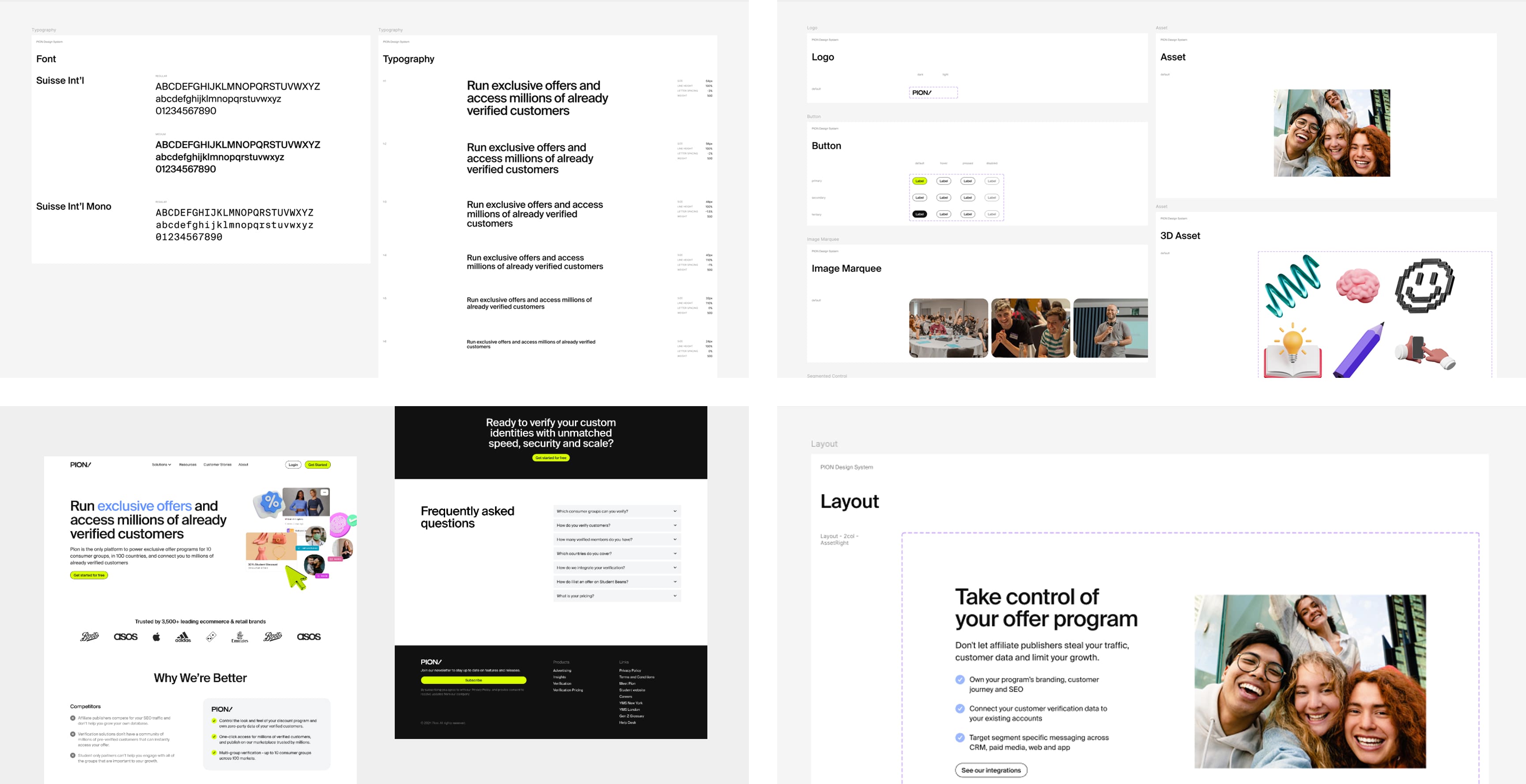
A design system is a structured library of reusable components, design rules, and code that allows teams to build consistent pages quickly.
Think of it as having three essential layers:
1. Visual Foundation: Colors, typography, spacing, and imagery guidelines that ensure everything looks cohesive.
2. Component Library: Pre-built, tested elements like headers, buttons, forms, testimonial blocks, and pricing tables that can be mixed and matched.
3. Usage Guidelines: Clear rules about when and how to use each component, ensuring brand consistency even when multiple people are building pages.
The magic happens when these three layers work together. Design systems are both speed enablers and governance layers—they let teams move faster while ensuring everything stays on-brand.
For teams looking to implement this approach systematically, having a comprehensive design system implementation checklist can help ensure nothing gets overlooked during the transition.
How do design systems speed up marketing teams?
Design systems accelerate marketing through four key mechanisms:
1. Remove dependencies
With a component-based system, marketing teams don't need to wait for design or development resources. They can build campaigns themselves using pre-approved elements. The dependency chain breaks, and bottlenecks disappear.
2. Increase assembly speed
Building with pre-made components is exponentially faster than creating from scratch. What used to require hours of design work and days of development now takes minutes of drag-and-drop assembly.
3. Maintain consistency
Because every component follows brand guidelines, there's no risk of off-brand campaigns. Marketing teams get creative freedom within defined boundaries, and brand teams get peace of mind.
4. Enable scaling
Once the system exists, launching additional campaigns has near-zero marginal cost. Your tenth campaign launches as fast as your first, because you're not starting from zero each time.
The Real Impact of Going From 4 Weeks to 24 Hours
The speed improvement is impressive, but the real transformation goes deeper. When campaign launches shift from weeks to hours, everything changes:
More experimentation
When testing an idea takes a month, you test fewer ideas. When it takes a day, you can test everything.
Faster iteration
Traditional campaigns are big bets with long feedback loops. Component-based campaigns enable rapid iteration. Launch, measure, adjust, relaunch. All within the same week.
No missed opportunities
Market timing matters. Competitor announcements, industry events, and trending topics create windows that close quickly. When your team can respond in hours instead of weeks, you stop missing opportunities.
Shift from reactive to proactive marketing
Perhaps most importantly, speed changes strategy. Instead of planning campaigns months in advance and hoping they'll still be relevant, teams can respond to real-time opportunities and feedback.
What this means for your team
If you're recognizing your team in this story, you're probably wondering about implementation. The good news: this transformation doesn't require massive upheaval.
Start with an audit: Map out your current campaign creation process. Identify the dependencies and bottlenecks. Most teams discover that 80% of their campaigns use similar layouts and components.
Think in systems: Instead of designing individual campaigns, design the building blocks that can create multiple campaigns. Focus on reusable components that reflect your most common needs.
Implement gradually: You don't need to rebuild everything at once. Start with your most common campaign types and expand the system over time. For organizations working with Webflow development teams, this approach can be particularly effective since the platform naturally supports component-based workflows.
The transformation from 4 weeks to 24 hours isn't just about speed—it's about unlocking your team's potential. When systems remove friction, creativity and results follow.
For teams interested in seeing exactly how Pion implemented this transformation, you can watch our detailed webinar covering Pion's design system approach in Webflow.
FAQs
What is a design system in marketing?
A design system is a collection of reusable components and rules that allow marketing teams to build consistent pages quickly without starting from scratch.
How long does it take to launch a campaign with a design system?
With a mature system, campaigns can be launched in hours instead of weeks.
Do design systems limit creativity?
No. They provide structure, allowing teams to move faster while staying on-brand.
Can marketing teams build pages without developers?
Yes. Component-based systems enable marketing teams to assemble pages independently using pre-approved elements.
Let's unleash your digital growth together