Free AI Visibility Score — See how AI finds and cites your website
Service
CRO
Turn traffic into measurable revenue growth.
Structured experimentation programmes designed to increase conversion rate, average order value and pipeline performance.
.jpg)
Why revenue plateaus after launch
Traffic without pipeline growth
You drive traffic through SEO, paid or outbound. But demo bookings and qualified leads don’t scale proportionally.
Funnel leakage
Visitors engage with content, but drop before high-intent actions. Small friction points compound into lost revenue.
Opinion-led optimisation
Landing pages evolve based on preference, not performance data. Without consistent structured testing, improvements stall.
How we work
How we approach CRO
A continuous, hypothesis-led experimentation engine built to turn traffic into qualified pipeline and measurable revenue.

01
Insight & opportunity mapping
We analyse behavioural data, funnel drop-offs and user journeys to identify high-impact test opportunities.

02
Hypothesis & experiment design
Each experiment is backed by a clear hypothesis, success metric and prioritisation score.

03
Test build & QA
Variants are built, QA’d and launched with accurate tracking.

04
Measure & learn
We analyse results against statistical significance and extract clear insights.

05
Implement & scale
Winning variants are implemented. Learnings feed into the next experiment cycle.
Key Capabilities
What we deliver

Scalable Webflow architecture
Develop modular, maintainable structures that support growth, performance, and security.

Enterprise-grade compliance
Implement processes and hosting standards that meet enterprise-level security and data requirements.

Custom integrations
Connect CRMs, analytics, or internal systems for unified workflows and automated data sync.

Localisation & region management
Build flexible Webflow structures for global content, translations, and multi-region control.

Documentation & governance
Define clear rules and usage guidelines to ensure your system scales without confusion.

Long-term partnership
Provide ongoing technical support, optimisation, and maintenance for enterprise-scale teams.

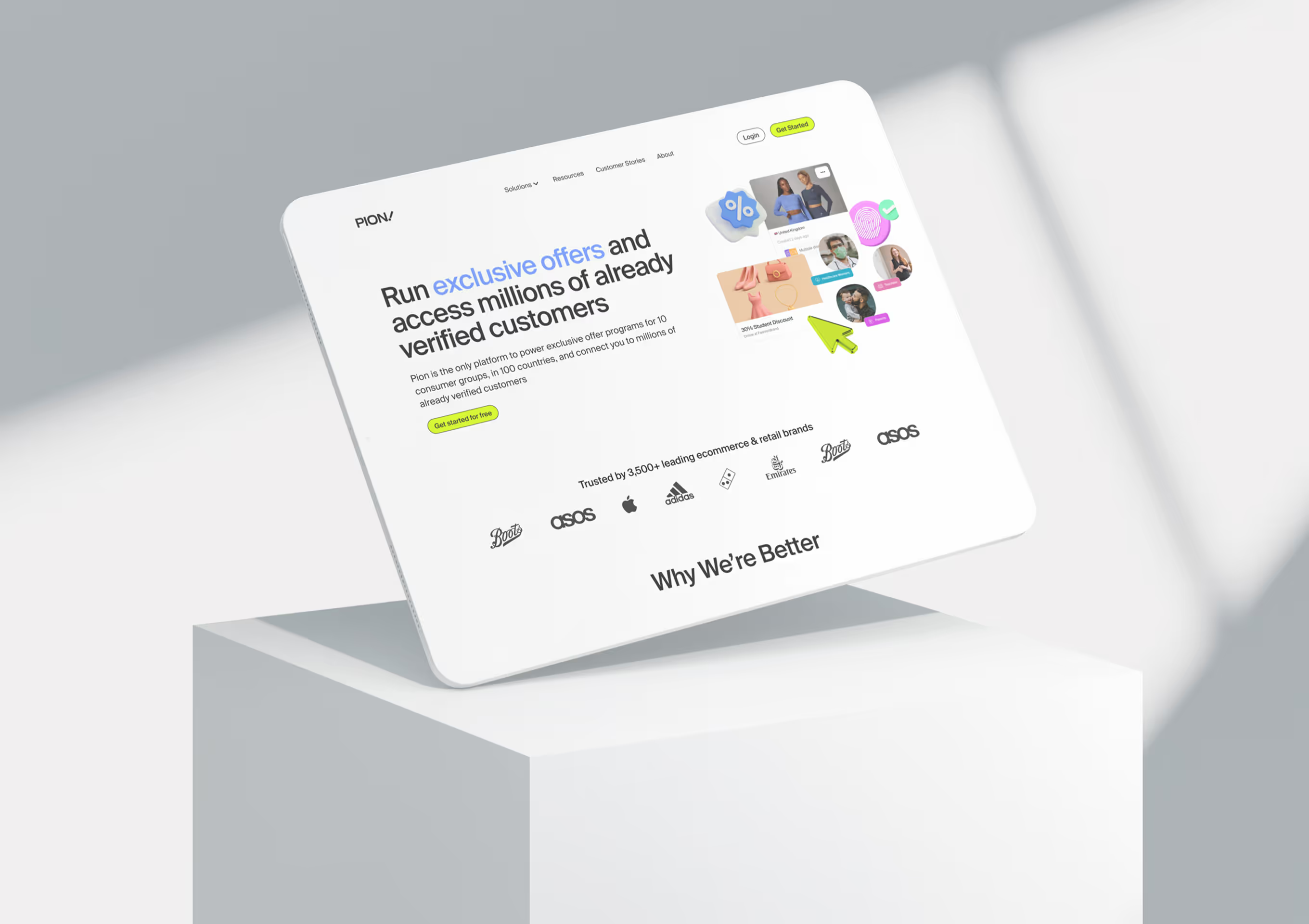
C&W partnered with Pion to rebuild their marketing site in Webflow, streamline their positioning, and create a scalable design system ready for rapid expansion.
FAQ
Common Questions
How quickly will we see results?
Structured experimentation typically requires sufficient traffic and statistical significance.
Early directional insights can emerge within the first 30–60 days, but meaningful, validated improvements are usually identified over a 3–6 month period of consistent testing.
CRO is designed as a compounding growth system, not a one-off intervention.
What if our traffic is too low?
CRO relies on statistically meaningful sample sizes.
As a guideline:
- Starter programmes suit sites with 20k+ monthly visitors
- Growth suits 40k+
- Scale suits 60k+
If traffic is lower, we may recommend focusing first on acquisition before running structured experimentation.
Do you guarantee uplift?
No.
We guarantee a disciplined experimentation process — not a specific percentage increase.
Every experiment is hypothesis-led and prioritised for impact, but results vary depending on traffic, funnel maturity and audience behaviour.
Over time, structured experimentation consistently improves conversion performance.
Do we need Platform Support as well?
No.
CRO includes implementation of experiment variants and rollout of validated improvements.
Platform Support is optional and suited for broader structural evolution, feature development or ongoing delivery beyond experimentation.
What tools do you use?
For Webflow builds, we typically leverage Webflow Optimize.
For broader experimentation requirements, we work with established platforms such as Convert or VWO.
Tool selection depends on traffic, complexity and integration requirements.
Do we need to purchase testing tools separately?
Yes.
Experimentation requires a dedicated testing platform. We recommend the most appropriate tool based on your stack, traffic and budget, and handle the full setup and configuration.
Tooling costs are billed directly to you.
Is analytics setup included?
Basic tracking setup required for experimentation is included within the programme.
In the first month, we include up to eight hours of tracking configuration. Ongoing test-specific tracking adjustments are also included.
If deeper analytics restructuring or complex GTM architecture changes are required, these may be scoped separately.
What happens if our tracking is poor?
CRO relies on accurate event tracking.
Before launching experiments, we review your existing GA4 and GTM setup. If core tracking gaps exist, we address the fundamentals required to run structured testing.
Larger data architecture projects are scoped separately.
Do experiments impact site performance?
Experiments are configured to minimise performance impact and are carefully QA’d before launch. Testing tools are widely used across high-traffic B2B and SaaS platforms.
How much input is required from you?
CRO is designed to minimise operational overhead on your side.
Once access to analytics, tracking and key stakeholders is established, we run the experimentation cycle independently — including analysis, hypothesis development, test setup and monitoring.
Your involvement typically includes:
- Initial alignment on growth priorities
- Monthly or fortnightly review sessions
- Validation of strategic direction
Day-to-day experiment execution does not require constant input from you.
What happens if a test does not win?
Not every experiment results in a statistically significant uplift — and that’s expected.
Each test generates validated learning about user behaviour, messaging clarity or funnel friction. These insights inform future hypotheses and improve prioritisation over time.
Structured experimentation is designed to compound learning, not rely on single-test wins.